 RJ Wilson | Imaging Components for Industry & Science
RJ Wilson | Imaging Components for Industry & Science
RJ Wilson | Imaging Components for Industry & Science
 We’ve been working with JAI for almost 40 years and they continue to offer innovation, value, performance, and capability. JAI’s extensive product line features:
Multispectral Prism-Based Area Scan Cameras
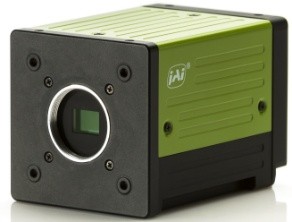
This series uses JAI’s prism technology to send the same image to 3 separate image sensors, each handling a different wavelength range. The sensors and pixels are perfectly aligned, providing multi-spectral metrology and inspection results and maintaining full sensor resolution per output channel.
Color Prism-Based Area Scan Cameras
A key problem with using a color camera with a single image sensor is the presence of a Bayer filter, where not every pixel sees every color and the sensor interpolates the pixel color values at each XY position.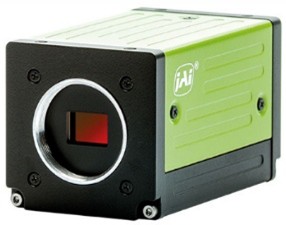
For applications where color fidelity and image resolution are critical, JAI has directly addressed this issue with a prism-based 3-sensor RGB camera. Each of 3 precisely aligned full-resolution sensors are equipped with hard dichroic prism filters that provide steep spectral cutoffs to direct pure red, green, and blue wavelengths to their dedicated image sensors. Color information is provided for each XY pixel position in the captured image, with full sensor resolution per color channel. In-camera color space conversion, supporting RGB to HSI, RGB to CIE XYZ, and RGB to sRGB/Adobe RGB transformations, is available on the camera itself, saving external processing time.
Single Sensor Area Scan Cameras
JAI single sensor area scan cameras are available in monochrome, color, and UV-sensitive models. A broad range of sensors, resolutions, and pixel sizes are available to help fine-tune performance to better match the application. 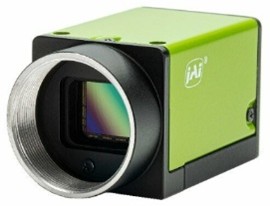
Prism-Based Line Scan Cameras
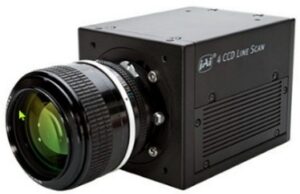
JAI has introduced some truly unique prism-based line scan cameras, ensuring that the position of a pixel in the image is the same at all wavelengths.
Single Sensor Line Scan Cameras
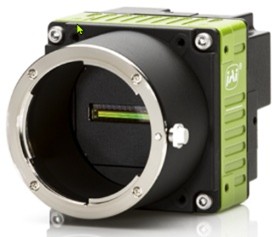
JAI monochrome single-sensor line scan cameras are available in 2K, 4K, 8K, and 16K, operating at very high rates and with direct connection to rotary encoders.
Multi-Line Sensor Line Scan Cameras
JAI line scan cameras are available with bilinear and trilinear sensors for RGB output when a prism is not required.
JAI Software
JAI provides several types of control software and development kits to support their cameras.
For additional information and a discussion on JAI camera selection, please contact R.J. Wilson, Inc. at 781-335-5500 or by e-mail at [email protected].
It is challenging to overcome brightness variations across a captured image to extract details from both darker areas and bright, sometimes oversaturated, areas of the image.
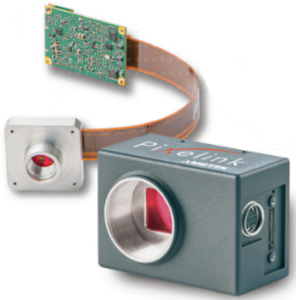
Pixelink has directly and transparently addressed this with its on-board HDR Imaging. When the HDR function is enabled, two images, one low-gain and one high-gain, are output to the built-in FPGA to process an HDR image. Using the HDR function cuts the maximum camera frame rate in half. However, the 7.1MP color or monochrome camera is still running at 28fps and the frame rate for the 2.8MP color or monochrome camera is 70fps, even with HDR “on”. This is plenty of camera speed for most applications.
As seen in the example above, the combination of a low gain image (left) used for bright areas of a scene, along with a high gain image (center) used for dark areas of a scene, allows details to be discerned in both the bright and dark areas of the camera’s computed output image (right) using HDR.
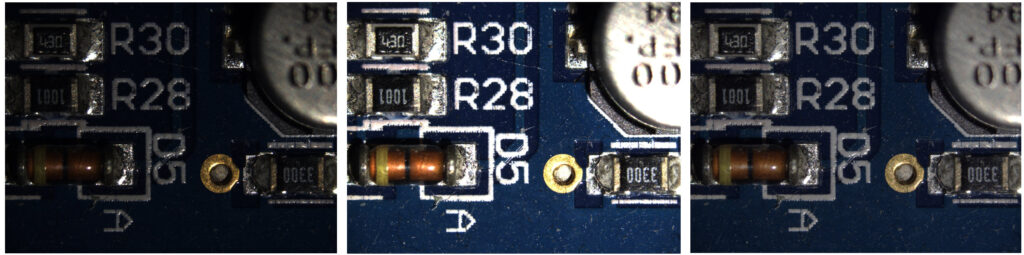
The Low Gain and High Gain Images are Created Simultaneously, Processed On-Board the Camera, and the HDR (High Dynamic Range) Image (right) is Output from the Camera.
As seen in the example above, the combination of a low gain image (left) used for bright areas of a scene, along with a high gain image (center) used for dark areas of a scene, allows details to be discerned in both the bright and dark areas of the camera’s computed output image (right) using HDR.
For additional information and a discussion on Pixelink camera selection, please contact R.J. Wilson, Inc. at 781-335-5500 or by e-mail at [email protected].